How to Choose a Roofing Contractor in Hartford County
A step-by-step framework for vetting Hartford County roofers. Check CT HIC licensing, manufacturer certifications, insurance, warranty terms, and know the red flags before signing.

A standard roof replacement in Hartford County runs $10,000 to $16,000 or more in 2026. At that price, hiring the wrong contractor turns a major home investment into a costly mistake. The good news is that filtering out unqualified roofers requires only a handful of verification steps, and every one of them can be completed before you sign anything.
This guide lays out a clear decision framework so you can evaluate any roofing bid with confidence.
Step 1: Verify credentials and insurance
Start here. No amount of charm or low pricing compensates for missing legal requirements.
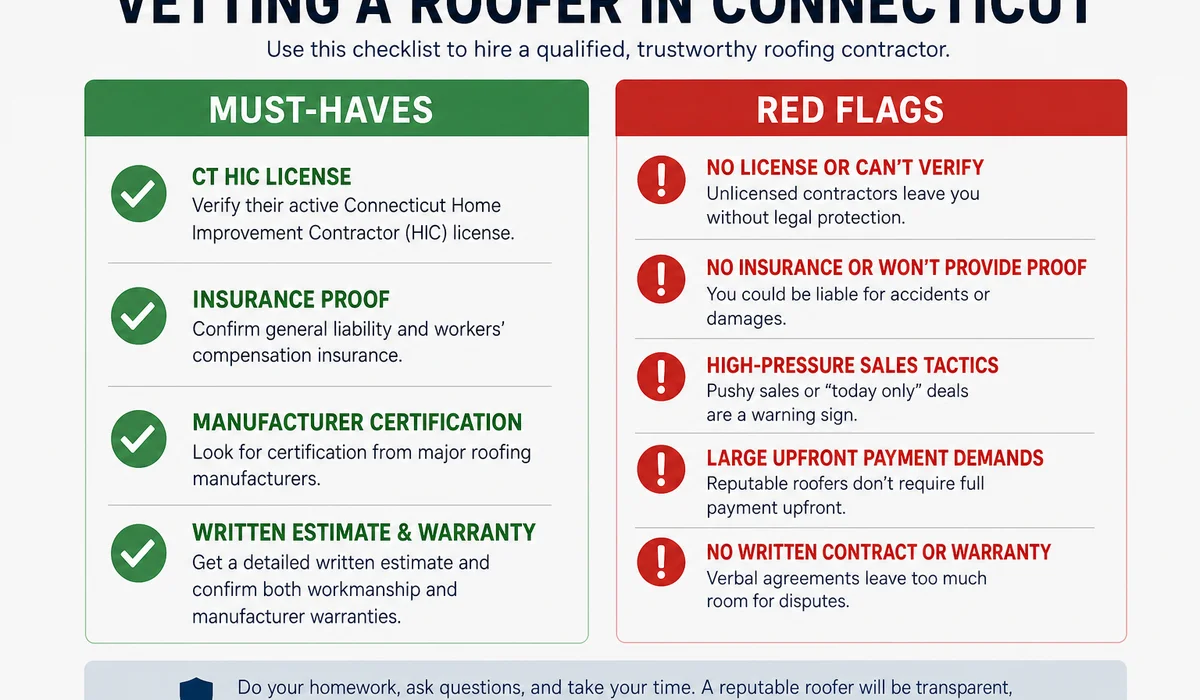
CT Home Improvement Contractor (HIC) registration. Connecticut law requires this registration for any residential project over $200. Ask for the HIC number and verify it on the Department of Consumer Protection website. The lookup takes about thirty seconds. If the number is missing or expired, stop the conversation.
General liability insurance. The state minimum is low. We recommend choosing a contractor who carries at least $1 million in general liability coverage. This protects your property if something goes wrong during the job.
Workers’ compensation. An uninsured crew member injured on your roof could leave you liable for medical costs. Ask to see the certificate of insurance before work begins.
Written, itemized estimate. A legitimate bid breaks out each line item: tear-off, materials, ice-and-water shield, ventilation, permits, and cleanup. A single lump-sum number on a business card is not a professional estimate.
| Requirement | Purpose | Red Flag |
|---|---|---|
| CT HIC Registration | Verifies legal standing with the state | Missing or expired number |
| General Liability | Protects your property during the project | Only the state minimum |
| Workers’ Compensation | Covers crew injuries on your site | Refuses to show certificate |
| Written Estimate | Details exact scope, materials, and cost | Single price with no breakdown |
Step 2: Look for manufacturer certifications
Once the legal basics check out, look for factory-level credentials. Programs like GAF Master Elite and Owens Corning Preferred Contractor represent the highest tier of manufacturer training.
Fewer than two percent of roofing contractors nationwide qualify for GAF Master Elite status. The program requires a minimum of seven consecutive years in business, verified customer satisfaction scores, and strong credit standing. A GAF certified roofer at this level can offer the Golden Pledge warranty, which covers materials for fifty years and workmanship for twenty-five years.
West Hartford Roofing holds both GAF Master Elite and Owens Corning Preferred designations. These certifications matter because they unlock extended warranty options that are simply unavailable from uncertified installers.
Step 3: Evaluate local track record
Hartford County’s freeze-thaw cycles, ice dams, and Nor’easters create conditions that contractors from milder climates have never dealt with. Prioritize companies with a long presence in the area.
- Years of local operation. A contractor serving West Hartford, Wethersfield, or Farmington for a decade or more understands these weather patterns firsthand.
- Photo portfolio of nearby projects. Ask for real addresses and real photos. A reputable company will have them ready.
- Separate workmanship warranty. This coverage must exist independently from the manufacturer’s material warranty. If the contractor will not put their own labor guarantee in writing, that is a problem.
- Willingness to share inspection photos. A professional who refuses to show you the condition of your existing deck before quoting repairs is not operating transparently.
Step 4: Know the red flags
Certain behaviors should end the evaluation immediately.
- Large upfront cash demands. Requesting half the project cost before materials arrive signals financial instability. A reasonable deposit is normal. Half the total in cash is not.
- Door-to-door storm-chaser pitches. Out-of-state crews appear after severe weather, work one season, and leave town with no warranty support behind them.
- High-pressure closing tactics. A professional contractor will hold a quote for several weeks. Anyone pushing for a same-day signature is not acting in your interest.
- Skipped permits. Connecticut requires a local permit for roof replacements to enforce building codes including the 24-inch ice-and-water shield requirement. Skipping the permit saves the contractor a small fee while exposing you to code violations.
- Vague price ranges. A quote reading “between $10,000 and $25,000” is not an estimate. It is a guess.
Questions to ask every candidate
Use these specific questions during any consultation. If a contractor cannot answer them clearly, keep looking.
- What is your CT HIC registration number?
- Do you carry at least $1 million in general liability plus workers’ comp? Can I see the certificates?
- Are you factory-certified with GAF or Owens Corning?
- Who pulls the local building permit?
- What does your workmanship warranty cover, and for how many years?
- Will the crew that inspects my deck also perform the installation?
- Can I see photos or addresses from three recent projects in West Hartford or nearby towns?
- How do you handle unexpected decking repairs, and what do you charge per sheet of plywood?
Write down the answers so you can compare candidates side by side later.
Comparing multiple estimates
Getting at least two or three detailed bids is always worth the effort. If one quote feels suspiciously low, someone is likely cutting corners on essential components like ice-and-water shield or proper flashing. If one quote feels inflated, the line-item breakdown will reveal where the extra cost sits.
Free estimates are standard across the industry, so the comparison costs you nothing but time. West Hartford Roofing provides fully itemized, no-obligation quotes. Talk to our licensed team and get a written estimate you can use as a reliable benchmark against any other bid.
Frequently Asked Questions
Does a CT roofer need a license? ▼
Yes. Connecticut law requires a Home Improvement Contractor (HIC) registration through the Department of Consumer Protection for any residential work over $200. If a roofer cannot show their HIC number, walk away.
What does GAF certification mean? ▼
It means the contractor has completed factory training and meets ongoing performance standards. Certified installers can offer stronger workmanship and material warranties. Fewer than 5 percent of roofers nationally hold GAF Master Elite status.
What's a red flag when hiring a roofer? ▼
No written estimate, no proof of HIC registration or insurance, and pressure for a large upfront cash payment. Storm-chasers who appear after severe weather and push for a same-day signature are the classic profile to avoid.
Related Guides
7 Warning Signs Your Roof Needs Immediate Attention
Curling shingles, ceiling stains, granule loss in gutters? Here are 7 signs your West Hartford roof needs a professional evaluation.
Architectural vs. 3-Tab Asphalt Shingles: A Clear Comparison
Learn the key differences between architectural and 3-tab asphalt shingles, including cost, lifespan, wind ratings, and which GAF or Owens Corning products suit Connecticut homes.
Asphalt Roof Lifespan in Connecticut: Timelines and Intervals
Asphalt roofs in CT typically last 20 to 30 years. Learn the specific intervals for inspections, the climate factors that shorten roof life, and when to start planning a replacement.
Connecticut Roof Replacement Cost: Real 2026 Numbers
Get real 2026 roof replacement pricing for Connecticut homes. Understand what drives cost, from roof size and pitch to material grade and permits, and learn how to read a proper quote.