EPDM vs. TPO for Commercial Flat Roofs: Choosing the Right Membrane
Compare EPDM rubber and TPO thermoplastic membranes on seam strength, freeze-thaw durability, energy savings, lifespan, and installed cost for commercial flat roofs in Connecticut.
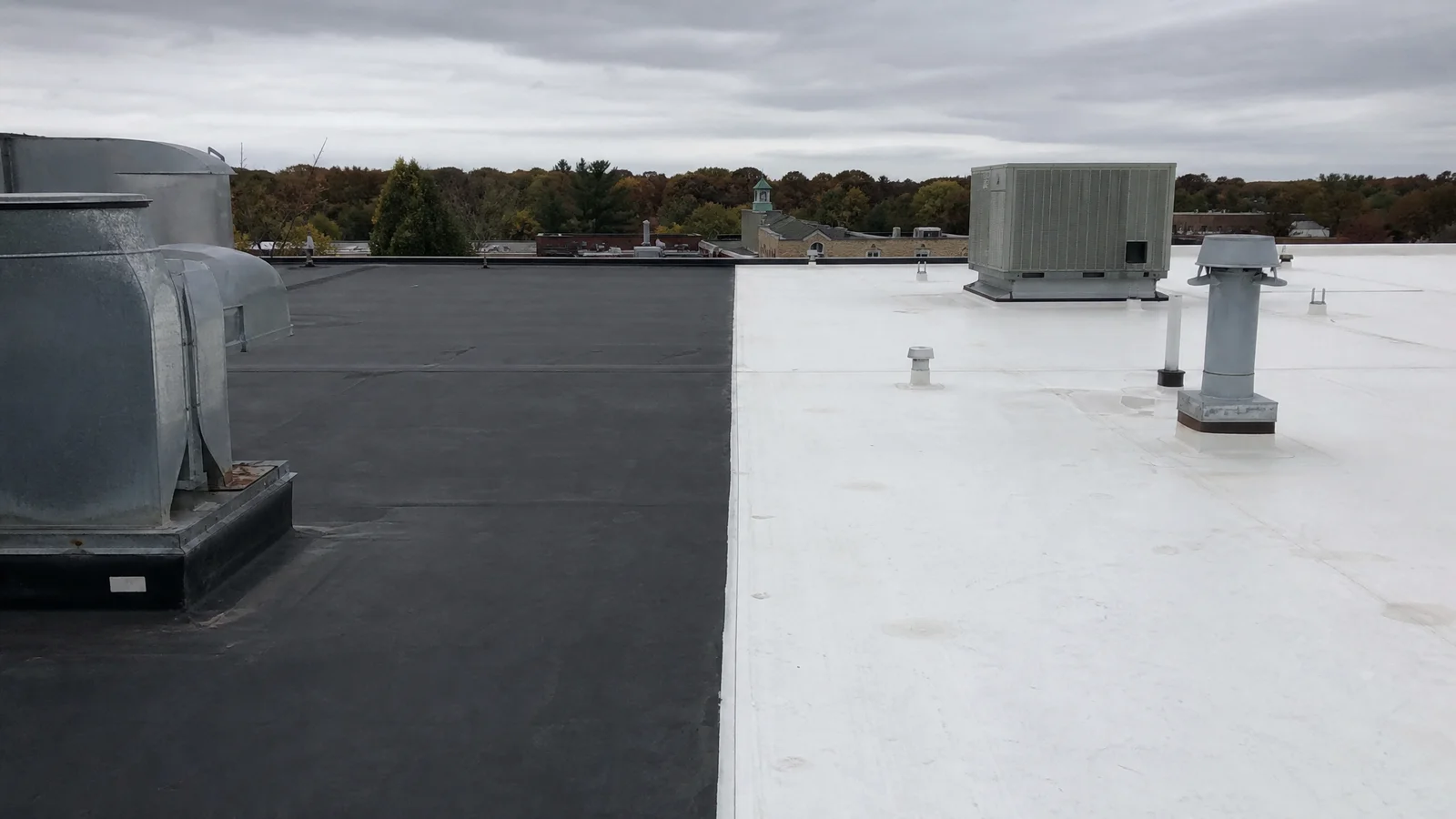
When it is time to replace a commercial flat roof, the conversation usually narrows to two single-ply membranes: EPDM synthetic rubber and TPO thermoplastic polyolefin. Both materials cover a large share of the low-slope commercial market, and both perform well in Connecticut’s climate when installed by an experienced crew.
The challenge is that they excel in different areas. This guide breaks down how each membrane performs across the criteria that actually matter for commercial building owners, so you can make a confident decision before committing to a system.
How the Two Membranes Compare
The table below reflects 2026 pricing and performance data for standard commercial flat roof installations in the Hartford County region.
| Criteria | EPDM (Synthetic Rubber) | TPO (Thermoplastic Polyolefin) |
|---|---|---|
| Market History | 50+ years of field data since the 1960s | 30 years on the market; modern formulations far better than early versions |
| Expected Lifespan | 20 to 30 years | 15 to 25 years |
| Installed Cost (2026) | $5 to $9 per sq ft | $6 to $10 per sq ft |
| Seam Method | Adhesive tape or liquid bonding; weakens over 15 to 20 years | Hot-air welded; bond is stronger than the membrane sheet itself |
| Solar Reflectance | Black surface absorbs heat; raises interior cooling load | White surface reflects up to 80% of UV energy; SRI commonly above 100 |
| Cold Weather Flexibility | Excellent; rubber stays pliable down to -40 degrees F | Good with quality brands; budget-grade sheets can stiffen in extreme cold |
| Repair Simplicity | Adhesive patch kits; no specialty equipment needed | Requires a hot-air welding machine and trained operator |
| Structural Movement Tolerance | Superior; rubber stretches to absorb settling and expansion | Moderate; less elastic than rubber under repeated thermal cycling |
| Cool-Roof Code Compliance | Fails IECC cool-roof thresholds without a reflective topcoat | Standard white TPO meets 2021 and 2024 IECC requirements out of the box |
| Visual Appearance | Industrial black finish | Clean white surface; professional look on visible rooftops |
Seam Technology and Long-Term Integrity
Seam failure is the number one cause of flat roof leaks, so seam construction deserves close attention in any membrane comparison.
EPDM seams rely on adhesive tape or liquid bonding applied in the field. The method works well for the first 10 to 15 years, but adhesive bonds gradually weaken as solvents evaporate and thermal cycling stresses the joint. Once seams begin to lift, repair frequency accelerates.
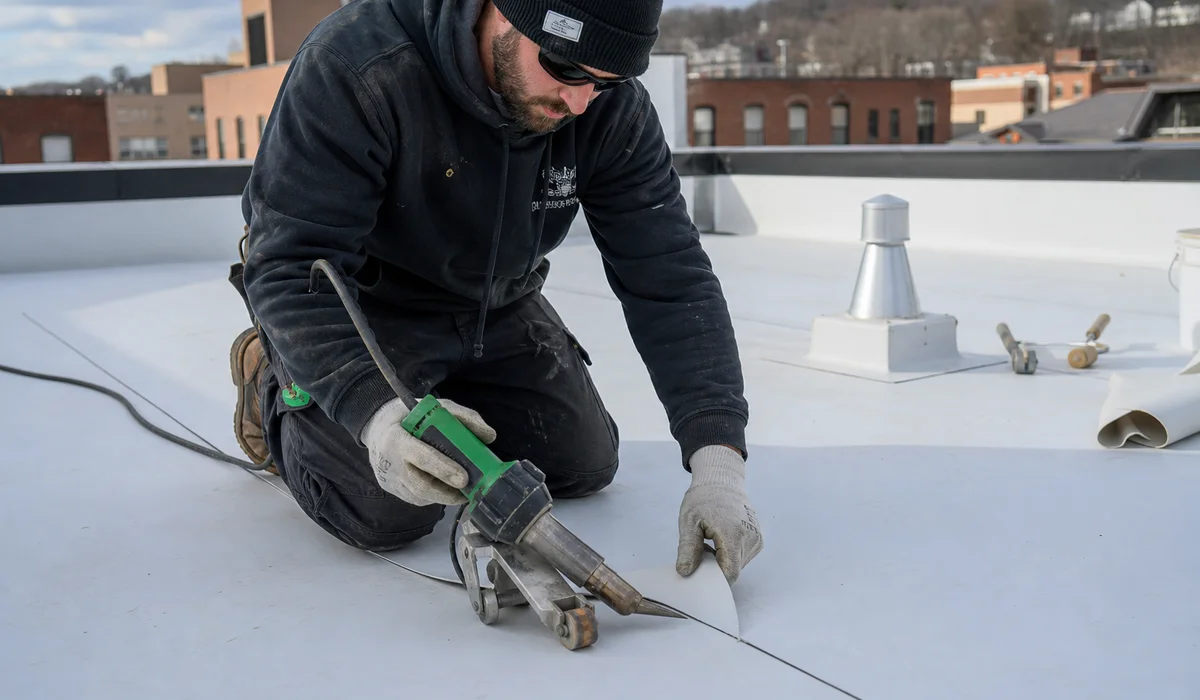
TPO seams are fused with a hot-air welding machine that melts the overlapping sheets into a single piece. A properly welded TPO seam is physically stronger than the surrounding membrane, which is a meaningful advantage in areas with heavy foot traffic or rooftop mechanical equipment. The trade-off is that field repairs also require welding equipment and a certified technician, making emergency patches more involved than a simple adhesive kit.
Climate Performance in West Hartford Winters
Connecticut’s freeze-thaw cycle is one of the toughest tests for any flat roof membrane. Winter temperatures can swing 40 degrees in a single day, and 38 to 52 inches of annual snowfall puts sustained weight on low-slope surfaces. Ice dam formation along parapets adds pressure that rigid materials struggle to handle.
EPDM’s rubber composition gives it a natural advantage here. The material maintains full flexibility even at subzero temperatures, stretching and contracting with the building rather than cracking. This makes it especially forgiving on older commercial structures in West Hartford where foundations have settled unevenly over decades.
High-quality TPO from manufacturers like GAF and Carlisle handles freeze-thaw cycling well, but budget-grade TPO sheets with thinner formulations can become brittle after several harsh winters. When specifying TPO for a Connecticut building, insist on 60-mil or thicker sheets and confirm the product carries a cold-climate performance rating.
TPO Advantages for Energy-Conscious Buildings
If reducing cooling costs or meeting energy code requirements is a priority, TPO has a clear edge. The white reflective surface bounces back a significant percentage of solar radiation, which directly lowers air conditioning demand during Connecticut’s humid summers when temperatures regularly reach the mid-80s.
Practical scenarios where TPO outperforms EPDM include buildings subject to strict IECC compliance requirements, properties with high summer cooling loads, new construction projects without existing membrane constraints, and structures with complex rooftop HVAC layouts where welded seals around penetrations create a more durable barrier. Local utility programs through Energize CT sometimes offer rebates for reflective roofing systems, which can offset the slightly higher material cost.
EPDM Advantages for Budget and Flexibility
Rubber roofing remains the go-to choice when budget discipline, repair simplicity, or compatibility with an existing system is the deciding factor. Property owners who need to match an existing EPDM membrane should stay with rubber rather than mixing membrane types, which creates problematic seam transitions.
EPDM also makes sense for buildings where structural movement is an ongoing concern. Older brick and masonry commercial properties settle at different rates across their footprint, and rubber absorbs that differential movement without tearing. Carlisle SynTec alone has manufactured over 20 billion square feet of EPDM, providing a massive real-world dataset that no competing flat roof material can match.
Alternative Materials for Specific Applications
While EPDM and TPO account for the majority of commercial flat roof installations, two other materials serve niche requirements worth mentioning.
PVC (Polyvinyl Chloride) looks similar to TPO but offers superior chemical and grease resistance. It is the standard choice for restaurants, food-processing facilities, and buildings with rooftop kitchen exhaust. Installed cost runs $7 to $12 per square foot.
Modified Bitumen is a multi-layer asphalt system with strong puncture resistance and good foot traffic durability. It suits buildings with heavy rooftop activity but typically lasts 15 to 20 years and carries higher installation risk due to torch-applied application.
Choosing the Right Membrane for Your Property
For most small to mid-sized commercial flat roofs, both EPDM and TPO will deliver reliable service when installed correctly. West Hartford Roofing has completed hundreds of both systems across Hartford County, and the consistent takeaway is that installation quality determines longevity far more than material brand. A crew that welds TPO every day will outperform a team that only handles it occasionally, and the same holds true for rubber.
The decision usually comes down to three practical questions: whether you are matching an existing system, whether energy code compliance requires a reflective surface, and whether your local utility offers rebates that offset the price difference. For a membrane recommendation tailored to your building, see our flat roof repair and replacement service or request an on-site evaluation to get a written assessment of your roof’s current condition and the best path forward.
Frequently Asked Questions
Is TPO better than EPDM? ▼
It depends on the building. TPO offers superior energy efficiency and welded seam strength, while EPDM provides proven flexibility, simpler repairs, and over 50 years of documented performance. The right pick hinges on your priorities, budget, and existing roof setup.
Which lasts longer? ▼
EPDM routinely reaches 25 to 30 years with proper maintenance. TPO can last 20 to 25 years, though its long-term track record is still developing. Quality of installation affects lifespan more than material selection alone.
Which is cheaper? ▼
EPDM has historically been the lower-cost option, but modern pricing puts the two within roughly 10 to 15 percent of each other. TPO may offset its slightly higher upfront cost through utility rebates and reduced cooling expenses.
Ready to talk to a roofer?
Read about our commercial flat roof repair service or get a free estimate.
Related Guides
Flat Roof Problems on Commercial Buildings: Warning Signs and Urgency Levels
Identify the most common flat roof problems on small commercial buildings, understand the urgency level of each issue, and know when repairs become critical.
Flat Roof Repair vs. Replacement: A Property Manager's Decision Guide
A side-by-side comparison of flat roof repair and replacement for property managers, covering cost thresholds, tenant disruption, warranty value, and the 15-year inflection point.