Flat Roof Repair vs. Replacement: A Property Manager's Decision Guide
A side-by-side comparison of flat roof repair and replacement for property managers, covering cost thresholds, tenant disruption, warranty value, and the 15-year inflection point.
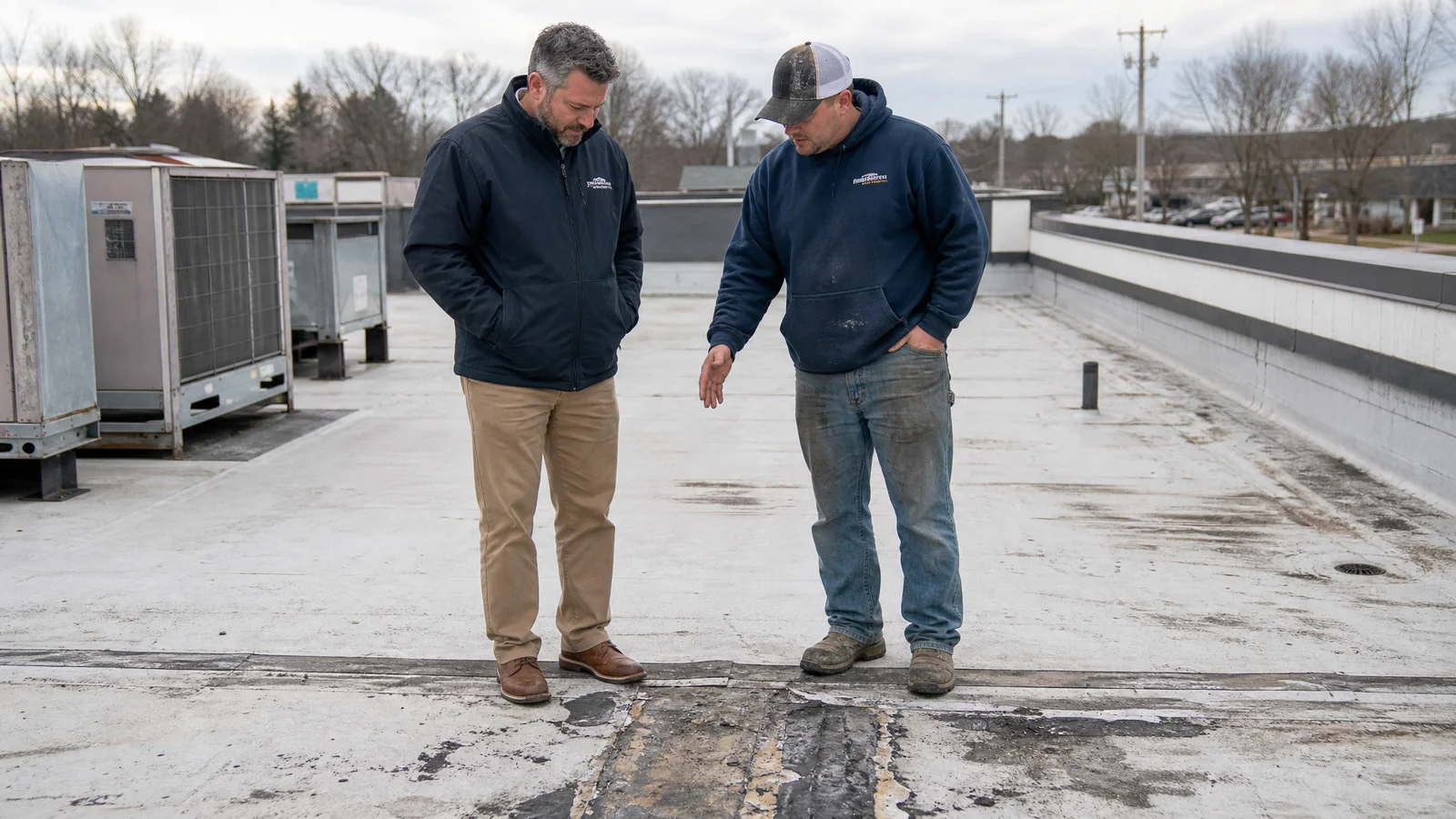
The flat roof repair vs replacement decision carries different weight for property managers than it does for owner-occupants. You are balancing tenant disruption, capital budget cycles, lease schedules, and long-term asset value rather than just comparing the upfront cost of two options. Getting this decision wrong means either wasting money on short-lived patches or spending capital on a replacement that could have waited three more years.
This guide puts the two paths side by side across the criteria that matter most for commercial property operations in the West Hartford area and across Hartford County.
Side-by-Side Comparison: Repair vs. Replacement
| Criteria | Targeted Repair | Full Replacement |
|---|---|---|
| Cost (2026) | $600 to $4,500 per repair call | $7.50 to $15 per sq ft installed |
| Project Duration | A few hours to 2 days | 3 to 14 days depending on building size |
| Tenant Disruption | Minimal; schedulable around business hours | Significant noise during tear-off; possible HVAC downtime |
| Warranty Coverage | Repair-only workmanship; no manufacturer warranty reset | 15-20 year material + 5-10 year workmanship; NDL options available |
| Best Roof Age | Under 15 years | Over 20 years or past warranty expiration |
| Damage Scope | Localized seam failures, isolated punctures, single-area ponding | Widespread cracking, chronic multi-area ponding, multiple active leaks |
| Budget Impact | 5 to 15% of replacement cost per event | Full capital expenditure; may qualify for depreciation benefits |
| Building Sale/Refinance | Patched roof may reduce property valuation | New roof with active warranty strengthens buyer confidence |
When Repair Is the Right Call
Repairing a commercial flat roof is almost always the better financial move when the membrane is under 15 years old and the damage is contained to specific areas. Localized failures like a few loose seams, isolated punctures, or a single ponding zone do not justify tearing off an otherwise sound system.
Repair makes the most sense under these conditions:
- The existing membrane is still flexible and showing no widespread cracking
- Standing water drains within the 48-hour threshold set by the NRCA
- Repair frequency is once per year or less
- Tenants cannot absorb the noise and disruption of a multi-day tear-off
- The capital budget for full replacement is not approved in the current fiscal year
At 2026 pricing, a targeted repair typically costs 5 to 15 percent of what a full replacement would run. If that investment buys the building three to five more watertight years, the math clearly favors patching.
When Replacement Becomes Necessary
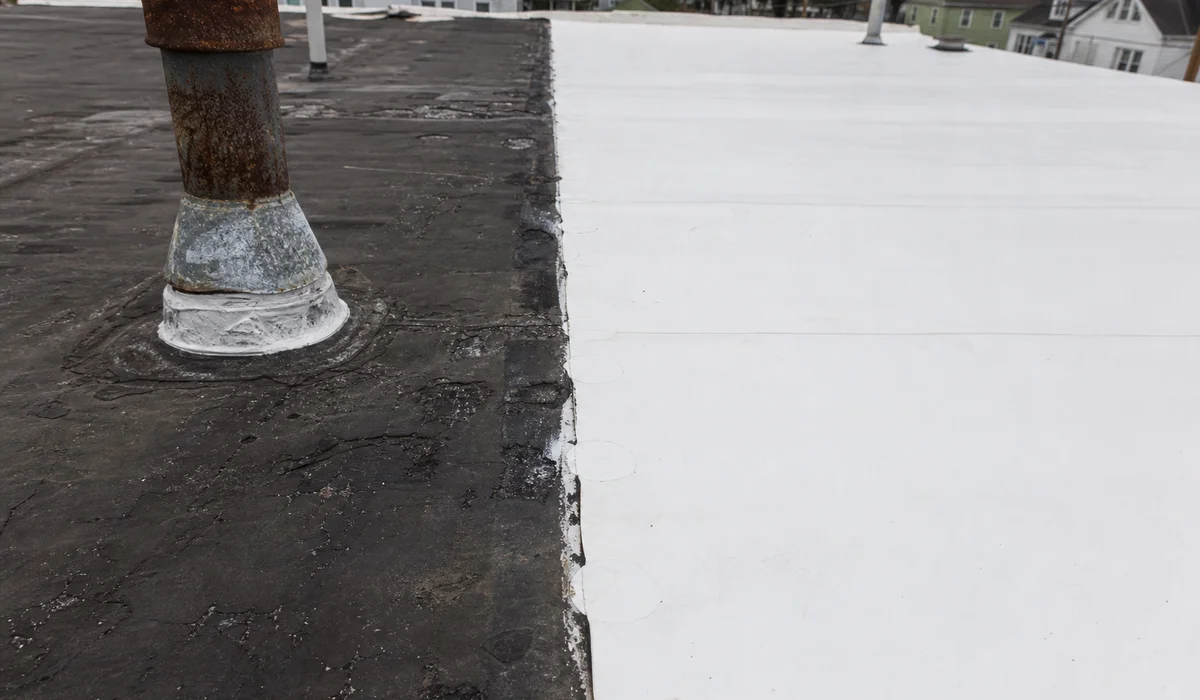
Replacement becomes the mandatory path when repair costs start compounding and the membrane shows systemic failure. West Hartford Roofing sees this transition most often on roofs past the 20-year mark where patching no longer holds for more than a few months at a time.
Plan for full replacement when you observe these conditions:
- The roof is past 20 years and exhibiting severe shrinkage, cracking, or brittleness
- Chronic ponding occurs across large sections that violate the 48-hour drainage rule
- Multiple active leaks continue despite ongoing repairs
- The manufacturer warranty has expired, leaving the ownership group fully exposed
- A building sale, refinancing, or lease renewal is approaching
- Three or more repair calls within a single year signal that the system is failing structurally
Replacement Budget by Building Size
| Project Size | 2026 Estimated Cost | Typical Application |
|---|---|---|
| 3,000 sq ft | $22,500 to $45,000 | Small retail or office space |
| 5,000 sq ft | $37,500 to $75,000 | Mid-sized commercial property |
| 10,000 sq ft | $75,000 to $150,000 | Large warehouse or industrial building |
Add $1 to $3 per square foot for full tear-off of existing materials. Tapered insulation to correct drainage slope adds roughly 15 to 25 percent on top of the base price.
The 15-Year Inflection Point
Most commercial flat roofs hit a critical inflection point around year 15. Before that milestone, standard repairs hold reliably and the cost-per-year of ownership stays low. After 15 years, several factors compound to change the math:
- UV exposure degrades chemical bonds in both EPDM and TPO membranes
- Seam adhesive dries out and releases from years of thermal cycling
- Each repair creates underlying moisture conditions that accelerate the next failure
If your budget planning window extends five years or longer, replacing at year 15 often costs less over the full window than patching through year 20 and then replacing. Running a ten-year cost projection makes this financial crossover visible.
Managing Tenant Impact in West Hartford
Tenant disruption is the operational variable that separates commercial roofing decisions from residential ones. A targeted repair takes hours to two days and can usually be scheduled outside core business hours. Noise is modest, and access impact is minimal.
A full replacement is a different situation entirely. Expect 3 to 14 days of active construction. The tear-off phase generates significant noise. Rooftop HVAC equipment may need brief shutdown while crews install new flashing around unit curbs. Weather-dependent scheduling means the project timeline can shift if storms are forecast.
Mitigation strategies include weather-tighting the roof at the end of each work day so partial completion never exposes interior spaces, scheduling the loudest work during off-peak hours, and communicating directly with tenants about the daily schedule before work begins.
Warranty Value on a New System
Operating a commercial building on an expired roof warranty shifts all water-damage risk onto the ownership group. A new flat roof system transfers that long-term risk back to the manufacturer through layered coverage:
- Manufacturer material warranty: Covers membrane defects for 15 to 20 years
- Workmanship warranty: Covers installation labor for 5 to 10 years
- Extended NDL coverage: No-dollar-limit warranties up to 30 years are available through certified installer programs, covering both materials and labor at full replacement cost
Structuring Your Maintenance Plan
Annual inspections are the simplest way to track where your roof falls on the repair-to-replacement timeline. Our roof inspection service provides a written condition report with prioritized findings, and our flat roof repair service handles emergency dispatch for active leaks.
For capital planning, we provide written replacement scopes 12 to 24 months before the expected end of a membrane’s useful life, giving your budget cycle time to absorb the expenditure. Request a commercial assessment to see exactly where your roofing asset stands today.
Frequently Asked Questions
When is replacement more economical? ▼
When repairs recur two to three times per year, the membrane is past its expected lifespan, or ponding is chronic across large sections. Running a five-year cost projection usually shows replacement winning over continued patching at that frequency.
Can you work around tenants? ▼
Yes. We schedule commercial work during early mornings, evenings, or weekends where possible, and communicate directly with tenants about any noise or access impact ahead of time.
What warranty comes with a new flat roof? ▼
Standard coverage includes a 15 to 20 year manufacturer material warranty plus a 5 to 10 year workmanship warranty. Extended coverage up to 30 years is available with certified installers and premium systems.
Ready to talk to a roofer?
Read about our commercial flat roof repair service or get a free estimate.
Related Guides
Flat Roof Problems on Commercial Buildings: Warning Signs and Urgency Levels
Identify the most common flat roof problems on small commercial buildings, understand the urgency level of each issue, and know when repairs become critical.
EPDM vs. TPO for Commercial Flat Roofs: Choosing the Right Membrane
Compare EPDM rubber and TPO thermoplastic membranes on seam strength, freeze-thaw durability, energy savings, lifespan, and installed cost for commercial flat roofs in Connecticut.